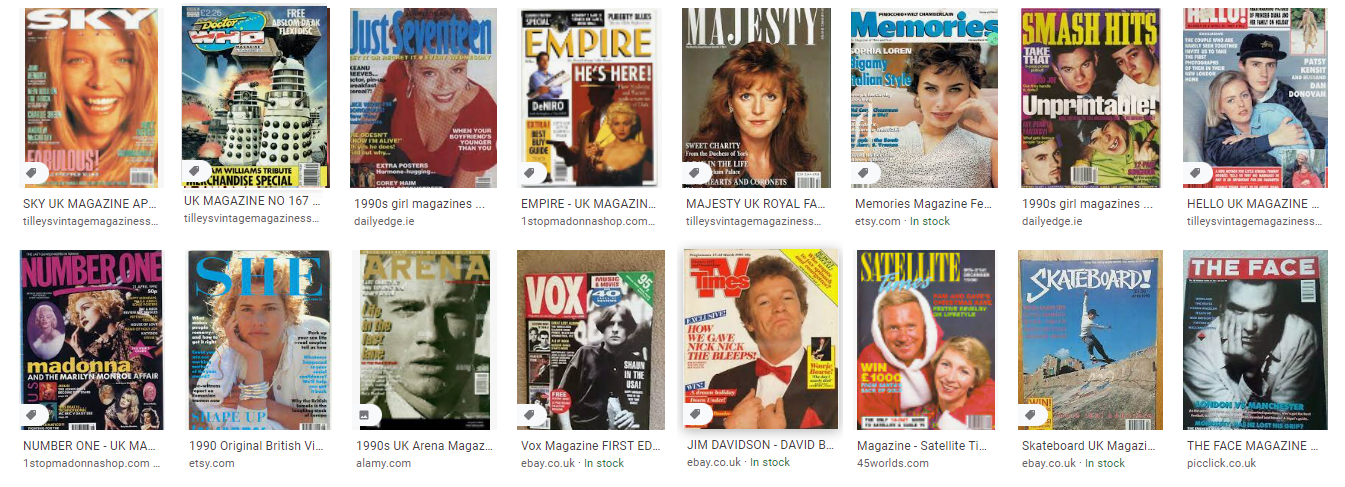
A ten minute rule bill recently brought before Parliament advocated a system of cover-page warnings for teenage magazines containing articles unsuitable for younger readers. This has brought to attention the disturbing content of many magazines aimed at teenage girls. So what are teenage girls reading?
Below is a sampling of four popular titles.
The Magazines
Chatterbox (monthly, BBC publications). Here we find plenty of photos of young men in the media and 'gossip' about them. Typically Chatterbox has a 'fashion' page, a 'Reader's true story' feature (February's subject was racism), a horoscope and problem pages. Letter writers are 9 to 13 years old. Most have problems getting on with friends and family. A separate section deals with medical problems. It is disturbing to read letters from girls of 10 and 11 obsessed with the opposite sex. Even in this the most innocent of the magazines surveyed nothing is done to discourage children from thinking in these terms. In fact the content of the rest of the magazine positively encourages such an outlook.
Mizz (fortnightly, IPG) features the same sort of 'celebrities' but is altogether more disturbing. The cover announces 'sizzling male model posters inside', 'Look great for your date!' etc. There are more 'fashion' pages and explanations, too, on applying make-up. 'Readers' true stories' recently included 'Down's syndrome won't hold me back' and 'My mum is HIV positive'. A good deal of the magazine is given over to readers' problems. This reveals evidence of sexual abuse and under age sex. Brook Advisory Centres are commended. The Gay and Lesbian Switchboard was also commended recently, although these magazines are nothing if not hetero-sexual in outlook. Unlike the other magazines nothing is said to discourage under age sex. Another unhelpful feature in a recent edition was a drawing of male genitalia (ostensibly to explain circumcision).
Just Seventeen (weekly, EMAP Elan). Similar to Mizz, this bigger magazine has more humour and 'in' talk. There is some variety. A recent issue had articles on UFOs, 'I was addicted to CDs', sickle cell anaemia and learning to drive. But again the big subject is 'boys, boys, boys'. Brook Advisory Centres are again promoted and there are plenty of problem pages. Despite the magazine's title, girls writing in are all under 17 but seem often to be sexually active. The magazine seeks to be 'responsible'. For example, it prints a reminder that under age sex is illegal. It lists five good reasons not to lose your virginity. The fact that you are not married is not one of them. As far as Just Seventeen is concerned, it is up to the individual to decide when to lose her virginity.
The same publishers also produce a monthly magazine Bliss. Double the size of Just Seventeen, it is more of the same with personality quizzes and advertisements adding to the bulk. A sinister element not found in the other magazines is the presence of 'Mystic Matt'. He introduces us to a pagan witch, shows us how to read rune stones and asks for details of 'problem spirits in your home' or psychic experiences. The problem pages again make for sad and disturbing reading. Bliss also contains a 16 page 'sealed section' which in the March issue included tales of first time sex and a complete guide to contraception. Bliss or Misery?
So what do we do we conclude? A number of publishers are clearly making great efforts to convince young girls that the most important thing in life is a sexual relationship with a man. There are other things in life, it is admitted, but this is the most important. Fornication is positively encouraged as biblical ethics are abandoned in favour of a shifting system of situation ethics. Partly as a result of this very attitude there is a great deal of misery amongst teenage girls. Some are miserable because they do not have a boy friend or have been made to feel inadequate about themselves in some way. Others have been lured into sexual activity and now, for various reasons, deeply regret it. Many, whether they reahse it or not, are being used by young men, hungry for sex, and are feeling under pressure to do things they do not want to do. Some have been raped and abused.
The picture one builds up is frightening. What can we do? Pointing out what is wrong is easy. Coming up with positive suggestions as to how to put things right is much more difficult. Certainly a system of age classification will do little. The idea of a young people's magazine has been mooted amongst Grace Baptists but barriers to its production have so far proved insurmountable. As individuals we can be a help to those we have some contact with if we are alert to their situations. Parents and all spiritually mature women have an important role to play in helping young women and girls. Ministers and others can be a help to teenage girls more indirectly.
A number of things can be said.
1. Girls do mature sooner than boys but do not let them grow up too quickly. One problem is that grown ups often stop playing with children after a certain age. No wonder they learn to go off on their own to watch TV or whatever. With a little imagination children can be kept young while they are still young.
2. Teenagers are curious and have many questions. They should feel free to ask them, as far as possible, whatever their nature. This is not easy to achieve but it ought to be developed.
3. Some teenagers are facing crises that they do not know how to handle. They need to turn to someone who can help. The world offers many such avenues. Believers should be there to help first.
4. Anyone who can read will want reading matter of some sort. We must do what we can to stimulate good reading. There are plenty of materials, if we are prepared to look. Do not underestimate the capacity of children to understand. When is the last time you passed on a copy of Grace or recommended an article in it to a teenager?
5. Further, we must teach children to be critical. When they watch TV or read books and magazines they must leant to approach them critically. The best way to foster this is by discussion. This will involve you reading and viewing what they like as well as what you like.
6. Exercise of censorship. What are children and teenagers reading and watching? Parents should know and should not be afraid to forbid certain items.
7. Do not underestimate the power of peer pressure. From the vantage point of middle age, peer pressure is difficult to credit yet it is a powerful force. We must educate children as to its existence, power and dangers. Believers have a duty to pass on the good news to the rising generation. For them it is, in some ways, much more difficult than for us. Let us pray for teenagers and children we know, that God will save them young and guide them through the minefield of adolescence to mature adulthood in Christ.
This article appeared in Grace Magazine in March 1996. Things have moved on quite a bit since then and so this article is chiefly of historical interest.