Showing posts with label Samuel Morton Peto. Show all posts

20210313

Samuel Morton Peto 1809-1889 Part 4 (Last Part)

Bankruptcy
In 1865 Peto travelled to America and wrote a book relating his experience. It was the financial problems that he hit the following year that forced him to leave Parliament two years later, despite the support of both William Gladstone (1809-1898) and Benjamin Disraeli (1804-1881) and many others.
Brian and Faith Bowers, describing what happened, write that “as everything that Peto did was on a grand scale, so was his failure”. In 1862 Peto, Betts and Crampton contracted to extend the London, Chatham and Dover Railway from London Bridge through Blackfriars to what is now Holborn Viaduct. On May 11, 1866, they had to suspend payment. The immediate cause was the failure of the previously rock solid Overend, Gurney & Co Bank, on whom they were dependent for funds while the contract was in progress. Peto generally employed directly rather than using subcontractors but this required more capital. Peto had weathered financial crises before but this time there was no escape and the following year he was in the bankruptcy court.
Spurgeon's letter to Peto at the time is preserved in a footnote in Spurgeon's autobiography
A little time ago, I thought of writing to condole with you in the late tempests; but I feel there is far more reason to congratulate you than to sympathise. I have been all over England, in all sorts of society, and I have never heard a word spoken concerning you, in connection with the late affairs, but such as showed profound esteem and unshaken confidence. I do not believe that this ever could have been said of any other man placed in similar circumstances. The respect and hearty sympathy which all sorts of persons bear towards you could never have been so well known to you as they are now by means of the past difficulties.
Peto received a similar letter from Baptist principal Joseph Angus (1816-1902).
The bankruptcy was raised at a Bloomsbury church meeting on July 5, 1867. Dr Brock was asked to write to Peto, who was absent, expressing “in the kindest way the sympathy of the Church with him and with Lady Peto under their heavy trial”. The church agreed to consider the matter further when Peto's affairs were finally arranged. Peto was thankful for the support and assured Brock that his chief concern had been to protect his creditors.
A year later, the bankruptcy proceedings now complete, the matter was raised again. Deacons James Benham (1820-1885), partner in a law firm, and George Kinnear were deputed to investigate and report. Their 5000 word report acknowledges Peto's ready assistance and admits that the system of finance Peto was involved in, though criticised by some, had been common practice. They admitted how difficult the whole process was to follow and that, as in this case, legal fictions were sometimes employed. However, they fully exonerated Peto of all wrongdoing or dishonesty. He had “conducted himself with perfect candour, openness, and integrity”. There were three criticisms, nevertheless. They felt he had put too much power in his own hands, taken on too much liability and had failed to avoid all appearance of evil. A reproof was later administered by the church though there was no church discipline.
One of the church's concerns was that Peto had allowed his name to be associated with others who had ultimately brought his name into disrepute. The Baptist historian J C Carlile (1861-1941) says that “after this catastrophe Sir Morton practically retired from public life”. Another Baptist historian, A C Underwood, observed that he “never again occupied quite the same place among Baptists”. In 1872 he was involved in alterations to the Metropolitan line, however, and work on the Cornish Mineral Railway.
*

One of Peto's biographers, Edward C Brooks, writes of Peto as at times flamboyant and one who loved public life and challenges in personal and business life. He was calculating, astute, shrewd, he says, but with a warm heart and generous disposition

- the sort of person you would walk up to and start a long conversation, knowing that there was scarcely a subject in which he lacked interest, be it politics, education, defence, architecture, art, religion, railways, social needs, the care of the poor, disadvantaged, the widow and orphan, all within a local, national, and international framework ...

A man, he concludes “with a rich and varied personality and a wide penetrating vision”. That is surely an accurate assessment of a man of faith who ought to be better known. He died at the age of 80 in 1889 and is buried in the churchyard at Pembury in Kent.
Readers will be interested to know that shortly after the above article was completed a new biography of Peto appeared. Hitting the Buffers by Douglas C Sparkes can be obtained from The Baptist Historical Society.

The article appeared in Reformation Today

Samuel Morton Peto 1809-1889 Part 3

Bloomsbury Baptist
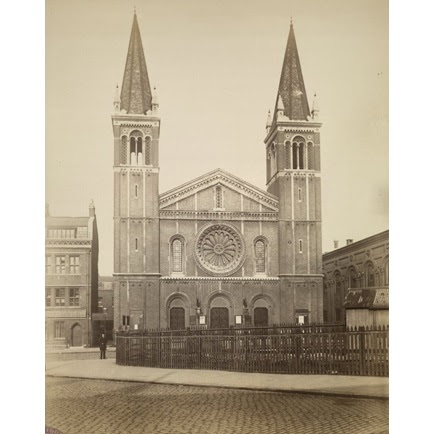
Bloomsbury Chapel, seating 1700, opened in December 1848 and a church of 52 members was constituted in July 1849. It was the first non-conformist chapel to stand prominently on a London street instead of being tucked away in some back alley. Good dissenters were wary of turning chapels into churches but as larger premises were required, buildings became more church like, more Gothic. Indeed, when Bloomsbury Chapel was being planned the authorities stipulated an ecclesiastical character for the building. Peto had seen that the site was a good one, not only handy for the Petos themselves in Russell Square but also on a new road between the comfortable squares of Bloomsbury to the north and the appalling slums of St Giles to the south, where a mission work was begun from the start, under George Wilson M'Cree (1822-1892). Peto also subsidised an elementary school in the basement. Apparently, the freeholders wanted the church to be built with shops beneath but Peto resisted that idea.
Tradition has it that when he sought to lease the land (freehold was not an option) he was told that non-conformist chapels were dull and a church should have a spire - “a spire?” exclaimed Peto, “my lord, we shall have two!”. Twin spires graced the towers of the chapel until 1951 when they were removed for safety reasons. Peto defended them against critics saying that they were necessary as staircases for ventilation. John Gibson (1789-1900) was the architect. Spurgeon, of course, preferred Greek to Gothic style. He observed that Peto was a man who built a chapel in the hope that it would be the seedling for another.
Peto was also instrumental in getting William Brock to become the first minister of Bloomsbury. They saw eye-to-eye on many important religious and social issues. While still in Norwich, Brock had use of a railway mission account with the Norwich Bank to be drawn on at his own discretion and funded by Peto. We say more about Brock in another chapter but he was the original preacher with a newspaper in one hand and a Bible in the other.
In 1855 the congregation at Bloomsbury paid off a much reduced portion of their debt of £10,000 to Peto and he used it to convert the disused Diorama behind Nash Terrace into another Baptist Chapel. He provided £5,000 for the project. Spurgeon preached there on many occasions. The street where what became Regent's Park Chapel once stood is called Peto Place (he is also honoured in Peto Street, near the East India Dock). The first minister was William Landels (1823-1899).
Peto also built a chapel in Notting Hill in 1863, beginning with materials that had been used for the Great Exhibition. Spurgeon's brother James Archer Spurgeon (1837-1899) was the first minister.
Peto was the generous benefactor and sponsor of more than 300 mission halls in East Anglia and elsewhere to serve the navvies. He also paid for missionaries to work among them. He supported Baptist Union schemes to provide for aged and infirm ministers. His missionary enthusiasm led him to defray the expenses of five deputations to India, West Africa and Jamaica, where he paid a debt of £9,000 and a Mountain was named after him. He also paid for a replacement schooner for Alfred Saker (1814-1880) to carry on work in the Cameroons and encouraged Baptist work in Italy.

Member of Parliament
Peto served as a Member of Parliament for two periods between 1847 and 1868. He was out of Parliament 1854-1859 as he was under government contract to build a railway in the Crimea for the army. It was for this work that he received his baronetcy in 1855. He was Liberal MP for Norwich 1847-1854, Finsbury 1859-1865 and Bristol 1865-1868. During this time he was a prominent figure in public life. He was constantly moving house. In 1843 he bought Somerleyton Hall near Lowestoft and extensively rebuilt it. He also restored the parish church and built an Independent chapel there. He had been a member of the old Devonshire Square Baptist Church under John Howard Hinton (1791-1873) but from 1848 was a member at Bloomsbury. When he moved to Pinner he joined Beechen Grove Baptist church, Watford, and retained membership there after moving to Blackhurst, Tunbridge Wells, Kent, where he attended the Congregational Church.
Among his other claims to fame is his making a guarantee towards the financing of The Great Exhibition of 1851, backing Joseph Paxton (1803-1865) the designer of the Crystal Palace. Chown says also that “Reedham orphanage, Haverstock Hill Working School, Essex Hall and Earlswood Asylum, all bear witness to his wide and generous philanthropy” and quotes a journalist saying of Peto and the social reformer Lord Shaftesbury (1801-1885), “Night after night you see one of these two men filling the chair at Exeter Hall. How I envy the Baptists Sir Morton Peto, whose twinkling and fine presence bespeak a broad humanity”.
In 1861 he introduced a Bill regarding the Burial of Dissenters in Churchyards. “I believe,” he said,

that were the measure I ask leave to introduce to become the law of the land, one of the causes of offence now existing would be removed; and if the Church of England is to prosper, I am sure it can only be by the exercise of a large-minded, large-hearted charity; by the adaptation of itself to the spirit of the times, and by its seeking the good of the community at large, not by an exclusive action, but by an earnest co-operation in works of faith and labours of love with all those denominations of Christians who, while differing in forms of worship and ecclesiastical polity, are yet united in the belief that the Bible is the only rule of faith, and the revealed will of God, the only guide to fallible man.
He reminded the House that by the rubric, three classes were excluded from Christian burial - the suicide, the ex-communicated and the unbaptised. He told the House that in his denomination those only were baptised who by credible evidence showed sincere repentance towards God and faith in our Lord Jesus Christ and asked if members of his denomination should be included in the same category with the suicide and the excommunicated. He concluded his speech
The abolition of the Test Act and other measures have done much to create a better feeling, and I beseech the House not to hesitate in its onward course. What is the first book you place in the hands of your children which most interests them? Is it not the Pilgrim's Progress of John Bunyan? And yet the spirit which dictated this rubric imprisoned John Bunyan himself for 12 years in Bedford Gaol; and Nonconformists have their martyrology, as extensive in its chronicles as any that Foxe ever wrote. But I rejoice that in the present day a better feeling exists. You do not value Milton's immortal works the less because they were written by a Baptist, and I beseech you to join with me in an effort to prevent our differences being exhibited at the grave, where at least we may hope the differences of life would be forgotten, and the mourners be permitted to resign to their last resting-place the precious remains of their friends in that way which would be most in consonance with their own feelings and those of the dead.
One writer says that on most social questions, as the first Baptist MP since 1784 he was progressive without being censorious or rigid. He supported the abolition of flogging in the armed services as dehumanising and advocated reforms of the criminal law where it put the rights of property above those of personal injury and natural rights. "Peto's Act" of 1850 simplified the administration of chapel trusts.

The article appeared in Reformation Today
Samuel Morton Peto 1809-1889 Part 2

Early days
Samuel Peto, who speaks so evangelically here, was born 52 years before, in 1809, at Whitmore House, Sutton in Surrey, where his father William was a tenant farmer. Samuel's grandfather, James, lived nearby in Cobham, where Samuel first went to school. After James's death the family moved to Marlow, Buckinghamshire, where Samuel continued his education, doing well in most subjects.
At the age of 12, he started at a boarding school at the top of Brixton Hill run by a Christian gentleman called Alexander Jardine (1788-1848), an Independent. The teaching was basic but included drawing lessons, something Peto was very good at. He also won a prize for a prose translation of the Latin hymn The Cross the Way to the Crown. His uncle. Henry Peto, a builder, regularly gave prizes for essays on religious subjects. Preachers such as William Jay (1769-1853) of Bath and John Leifchild (1780-1862) of Craven Chapel, Regent Street, often preached at joint meetings with the nearby girls school run by Mr Jardine's sister. A biographer says that Peto “well remembered going to Surrey Chapel and hearing Mr Jay preach … Rowland Hill's funeral sermon from the text: Howl, ye fir-trees, for the cedar is fallen!” Peto would have been in his early twenties by that time.
When he was 14, he was apprenticed to Uncle Henry with whom he lived at 31 Little Britain. In this period he rubbed shoulders with workmen and learned various aspects of the building trade. including bricklaying. at which he was most competent. A later writer says “He familiarised himself with what can be called the idiosyncrasy of the English mechanic” something that would stand him in good stead in days to come.
Henry Peto (1774-1830) seems to have been a strict but godly man. In 1830 he died, leaving the business to 21 year old Samuel and his cousin Thomas Grissell (1801-1874), who had been Henry's apprentice, then his partner. This was the first of a series of business partnerships that Peto entered into. In this period, he was involved in building the old Hungerford Market, where Charing Cross Station now stands; Nelson's column; several theatres and clubs and many private dwellings. He also built churches, including one for the evangelical churchman Henry Blunt (1794-1893). They nearly lost the contract for Hungerford Market as Peto was thought to look too youthful to be competent. There was also a good deal of work on the Great Western (for Brunel), South Eastern, London and South Western and Eastern Counties Railways (well over 200 miles of track). This period lasted from 1830 until 1846 when he and Grissell began the work on the new Houses of Parliament that still stand today.

Entrepreneur
After 1846, railway work dominated the agenda. Grissell was not happy about the risks involved with this and the partnership was eventually dissolved. Peto worked firstly with his brother-in-law Edward Ladd Betts (1815-1872), then (from 1854) with Betts and Thomas Brassey (1805-1870), then Brassey, Betts and William Jackson (1805-1876) and finally with Betts and Thomas Russell Crampton (1816-1888). He was involved in work on railways all over England and beyond - in France, Italy, Germany, Scandinavia, Austria, Spain, Russia, North Africa, Argentina, Canada and Australia.
Peto was twice married. In 1831 he married his partner's older sister Mary Grissell (1811-1842). Their children were Mary, Annie and Sophia (born in 1832, 1834, 1836) and Samuel and Henry (1839, 1840). Sophia was only 20 when she died.
On Mary's death, Peto published for family and friends a 40 page memorial containing many extracts from her diary and notebooks. An Anglican, she was clearly a spiritually minded woman. In 1842, he remarried, to Sarah Ainsworth Kelsall (1821-1892) of Rochdale. They had six sons and four daughters. She is often cited as the one who persuaded him to take up Baptist beliefs although he had already become an admirer of the open communionist and mild Calvinist William Brock (1807-1875) of St Mary's Baptist Church, Norwich. In 1846 he became co-treasurer of the Baptist Missionary Society. Peto himself claimed that his loan to them of Alfred Henry Baynes (1838-1914), as secretary, was the greatest service he ever rendered the BMS. From 1855 to March 1867, he was sole treasurer. He was also Chairman of the Dissenting Deputies, “the premier non-conformist group for protecting civil rights”, 1853-1855 and again 1863-1867. He resigned from these roles after being made bankrupt in 1866.
The article appeared in Reformation Today

Samuel Morton Peto 1809-1899 Part 1

If the truth be told we are a little bit ignorant about Reformed Baptists n the nineteenth century. We may know about pioneers such as Keach and Bunyan or eighteenth century men like Fuller and Carey but when it comes to the nineteenth century Spurgeon is something of a lone figure in our thinking. The story of the life of the preacher Archibald Brown by Iain Murray published the year before last has perhaps turned the tide a little and at the end of last year an excellent paper was given to the Westminster Conference by Jeremy Walker on the military figure Sir Henry Havelock. There are a host of other interesting characters to consider, however, and here we want to say something about Sir Samuel Morton Peto.
This English entrepreneur, civil engineer and railway developer was also an MP for many years. At one time he was the biggest employer of labour in the world. He managed the construction firms that built many major buildings and monuments in London, including The Reform Club, The Lyceum, Nelson's Column and the then new Houses of Parliament. He also became one of the major contractors in the building of the rapidly expanding railways of the time. Of special interest to Baptists is his role in the building of Bloomsbury Central Baptist Church, where he became a deacon and the fact that he laid a foundation stone for the Metropolitan Tabernacle.

Speech at the Metropolitan Tabernacle
We begin by quoting at some length a speech he gave on Tuesday April 2, 1861, one of a series of meetings marking the opening of the Metropolitan Tabernacle, to which Peto had contributed the first £5000.

When invited to lay the first stone of this building, I deemed it a high honour and privilege ... to preside tonight at the meeting of the Baptist Brethren of the metropolis, I deem also ... an honour and a privilege. Let me say ... how much I sympathise with all of you in meeting in this magnificent building ... under circumstances of the most gratifying character .... I recollect having said when the first stone was laid, that I saw no reason why this building should not be opened free from debt ... that anticipation has been abundantly realised! ... My thoughts naturally recur for a moment to the past. Mr Spurgeon has spoken of .. . the sufferings of our forefathers. They have laboured; we have entered into their labours. The result ... is shown in the ability of God's people connected with our denomination to raise a temple like this to his praise; and we have to acknowledge how much we owe to our forefathers in the opportunity we have of giving as a privilege, not as an exaction, and in seeing such a result of giving as this edifice displays.


There are many grounds on which we rejoice ... first …. that which was referred to ... on the evening of the opening day - Christ is preached and therein do I rejoice; yes, and I will rejoice. ... your pastor said that with all the misconceptions entertained with regard to his ministry, there was one point about which there could be no misconception - he thanked God he could say from his heart he had simply preached Christ. Now I believe the evidence we have in this building is no mean one that he has preached Christ - because if ministers have recourse to … any other than that of preaching Christ, we soon find … empty pews show the result! There is an underlying stratum in the deep feelings and hearts of our countrymen of reverence and love for the old Gospel which nothing else can supplant. The great strength of this country is that ... the people at once refer to the Law and to the Testimony, and that which is not found written there has no place in their reverence or their esteem!

... next ... the feeling that the privilege we have of worshipping God according to our consciences in this and every other edifice connected with His praise is to be traced to the result of the sufferings of our forefathers. But that privilege has entailed on us an adequate responsibility. In reading ... the Puritan Fathers, I am struck to see how deeply they were impressed with the principles on which they acted. They were not Nonconformists because their fathers were; they would themselves have gone to the stake to assert the principles connected with the Headship and the position of the Great Head of the Church in the sole right of sovereignty within that Church. In the present day there is entailed on us a great responsibility in guarding … these privileges. There is not only a desire on the part of the State to keep the Church so-called allied to the State, but to … intermeddle with other denominations. If we find the Church as we understand it, in the slightest degree interfered with, we must as one man arise and say we will never allow the privilege of the Headship of the Great Head of the Church to be interfered with by any State … No one can say more fervently than the Baptists, "God save the Queen," but while we render to Caesar the things that are Caesar's, we must have respect to the commandment which enforces that nothing of Caesar's shall touch that which is God's.

We ... congratulate ... the pastor, deacons, and members ... on the accomplishment of this great work, without any feeling excepting that of devout thankfulness to God for what He has enabled them to achieve! And we desire that abundant success may attend the proclamation of the Gospel in this building. Long may the pastor be spared to minister to a devoted, loving and affectionate people! Long may he be surrounded by deacons ... able and willing to take the stroke oar … long may he have the power of the Holy Spirit attending an effective ministry and witnessing every month in that baptistery to the result of his labours! ...

Among Evangelical bodies … there may be slight differences, and will be among men who think for themselves - yet in the great fundamental and vital Truths of godliness, there exists no difference ... and we only rejoice in so far as our ministry is made effectual in the way I have mentioned. Look at the influences which will go forth from this Church - … schools brought together … children instructed in the knowledge of God and Christ! Look at the evangelical labours of the Brethren who constitute the Church in the surrounding districts, teaching and preaching Christ! Mr. Spurgeon will not conceive that his members, when they have simply attended …. have done their duty, but will feel that they must become living Epistles of Christ, known and read of all men! And then, while we shall no doubt consistently maintain that great Truth which we feel has been committed to us, we shall live in harmony with all those who hold the great, vital truths of godliness. One cannot but feel a most anxious desire and hope that long after our Brother is called to the upper sanctuary, his place may be filled ... by those who, like he, will lead their hearers constantly to Christ, and that this will not only be a monument to the praise of God in our own generation, but in many generations following! ...

We do rejoice with you ... I have told you the grounds ... not a mere sentiment, a mere effervescent feeling, but that true bond of brotherhood kindled in the heart by love to the same Saviour, by adopting as we do from sincere conviction those Truths which we hold to be vital and necessary. It is to the assertion of those Truths that we desire to see not only this, but every edifice in connection with our denomination, so that in regard to all our churches and their pastors, there may be no doubt that they act from one principle - a love to Christ and a desire to follow Him - for it is in following Him, alone, that they honour Him!
In a little booklet on Peto, Leslie Chown says that 'Peto was among the first to recognise the genius of Spurgeon' and sent him a reading lamp of his own design for use on train journeys. 

The article appeared in Reformation Today